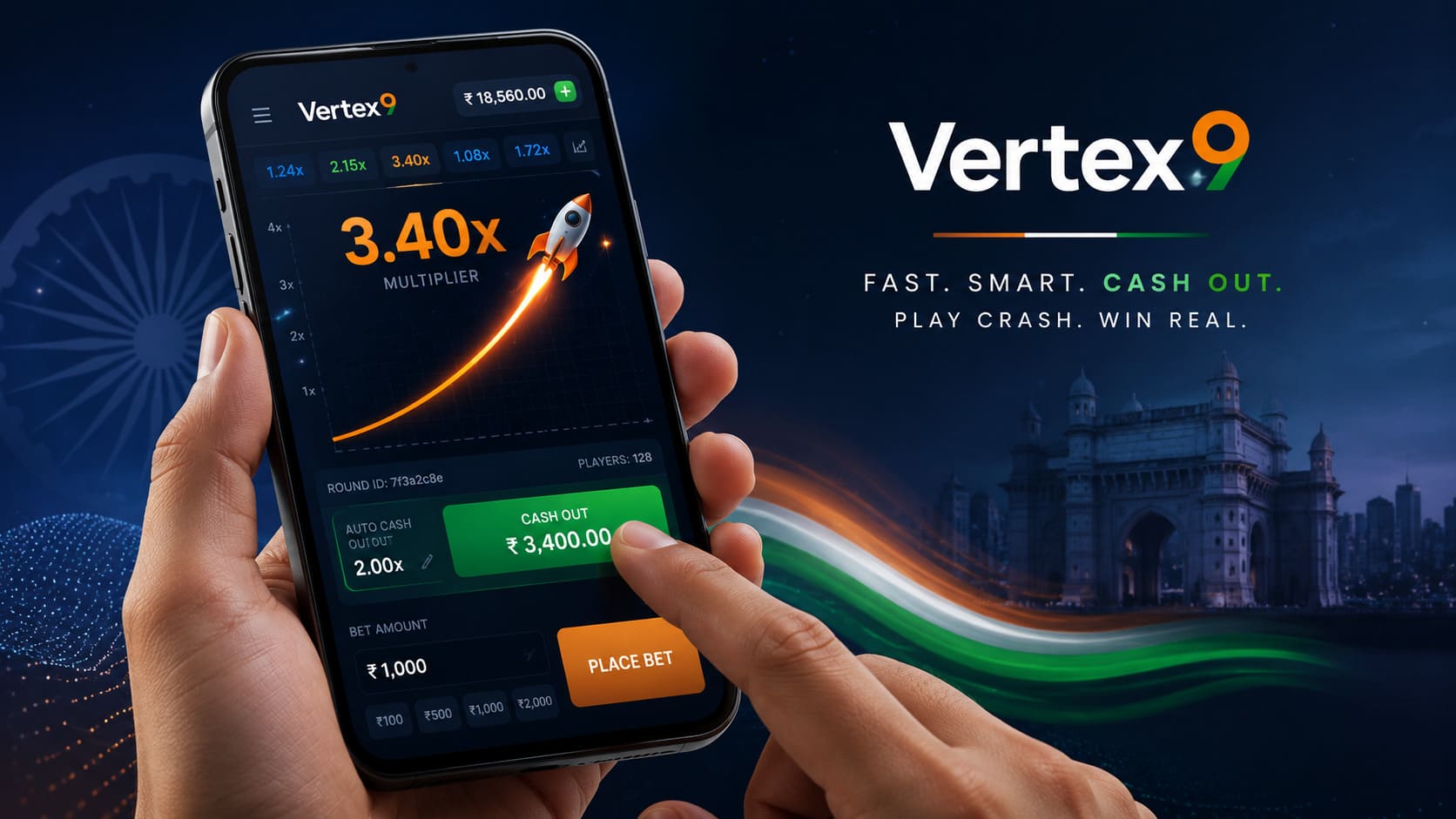
Crash games are built around one very simple question: how long are you prepared to wait?
A multiplier begins at 1.00x and starts climbing. It might reach 1.20x, 2.00x or far higher. At some unpredictable point, however, the round crashes. Anyone who has already cashed out keeps the return shown on screen. Anyone still waiting loses the amount placed on that round.
That is the entire idea.
There are no complicated card combinations to learn, no reels to study and no long rulebook to work through. You place an amount, watch the multiplier rise and decide whether to leave or keep going.
It sounds straightforward, but that simplicity is also what makes the format risky. The player controls when to press the cash-out button, yet has no control over when the game will stop.
There is also an important legal point for Indian readers. The rules surrounding real-money online games changed significantly in 2026. Before searching for a crash game real money platform, it is worth understanding both the game itself and the current legal position.
What Is a Crash Game?
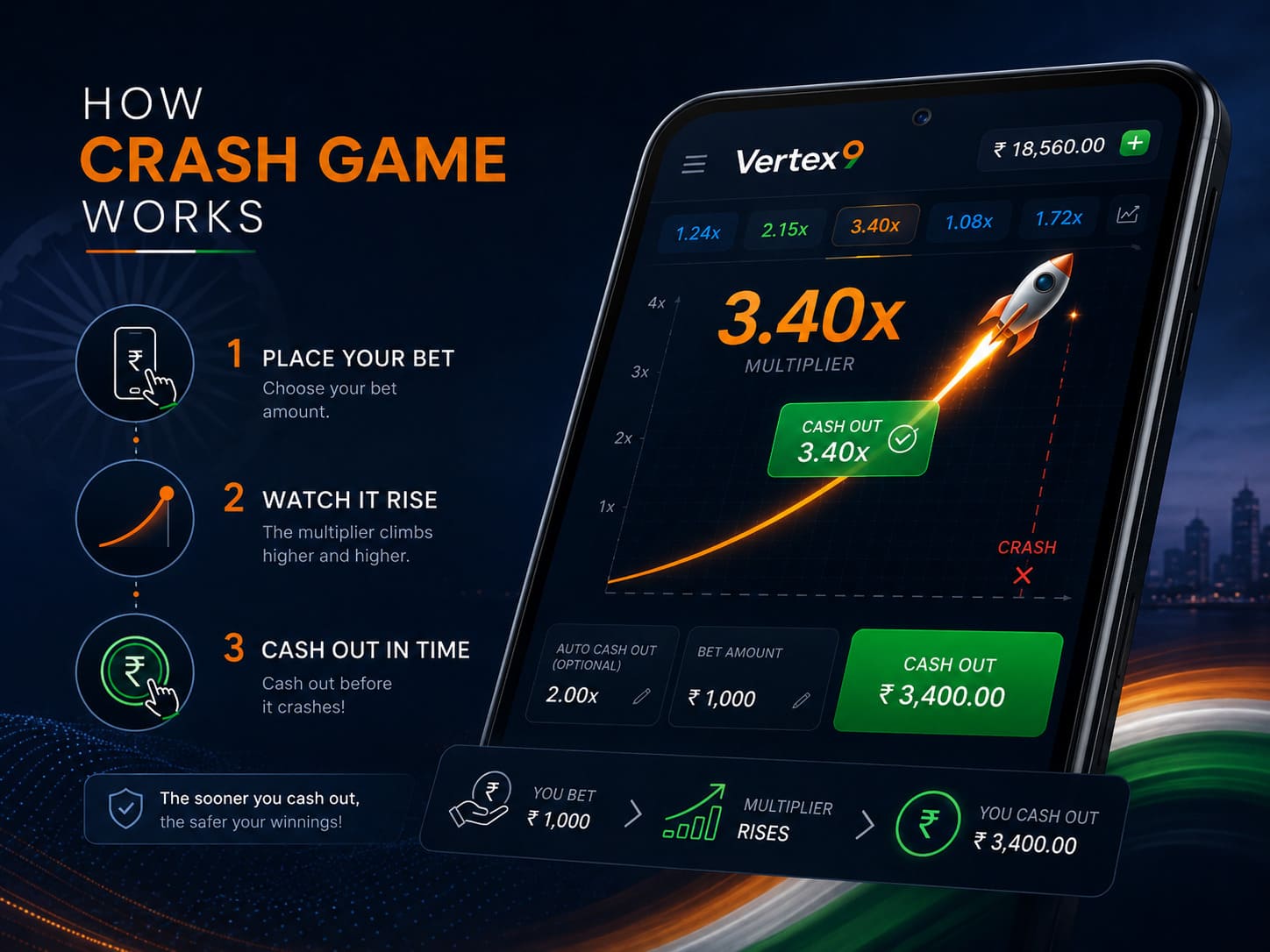
A crash game is a fast online game based around a rising multiplier.
The graphics vary from one version to another. Some use a rocket, aircraft or racing vehicle. Others simply show a line moving upwards across a chart. The visual theme may change, but the basic structure usually remains the same.
At the beginning of a round, the multiplier starts close to 1.00x. It then rises until the round suddenly ends. The exact stopping point is not shown in advance.
A player who exits before the crash receives a return based on the multiplier reached. A player who waits beyond the crash loses the stake placed on that round.
For example, a cash-out displayed at 1.50x would normally mean a total return equal to 1.5 times the original stake. The important detail is that the original stake is usually included in that figure. A 1.50x return is therefore not the same as a 150 per cent profit.
The exact calculation can vary by game, so figures shown on screen should never be taken at face value without understanding the rules.
How Does a Typical Round Work?
A crash game round is normally over within seconds.
Before it begins, the player selects an amount. Once the round starts, the multiplier moves upwards. The player then decides whether to cash out immediately, wait for a chosen target or continue watching in the hope of reaching a much larger multiplier.
The tension comes from not knowing when the crash will happen.
Leaving early can feel frustrating when the multiplier continues climbing after the cash-out. Waiting longer can feel rewarding when the game reaches a high number. However, the same decision can also result in losing the entire amount placed on that round.
This creates a constant push and pull between caution and greed.
The game may look calm at 1.10x, tempting at 1.80x and exciting at 3.00x. By the time the number becomes unusually high, players may feel that they have already waited too long to leave. That feeling has no effect on the outcome, but it can strongly affect the decision being made.
Manual Cash-Out and Automatic Cash-Out
Most crash-style games offer either manual cash-out, automatic cash-out or both.
With manual cash-out, the player presses a button during the round. The request must be registered before the crash. A delayed connection, slow device or late reaction may therefore matter.
Automatic cash-out allows a target to be selected before the round begins. If the multiplier reaches that target, the game attempts to cash out automatically.
Auto cash-out can make a pre-planned decision easier to follow, but it does not predict the result. It also does not guarantee that the target will be reached.
Setting an automatic exit at 2.00x does not mean the player will receive 2.00x. The round may crash at 1.01x, 1.50x or any other point before that target.
Auto cash-out is simply an execution tool. It does not change the underlying risk.
Why Do Crash Games Feel More Skill-Based Than They Are?
Crash games give players a button to press, and that can create a strong sense of control.
You choose the stake. You choose when to leave. You may also choose an automatic cash-out point. These are real decisions, but they do not determine the crash point.
That distinction matters.
A player can control their exposure, but not the event producing the result. Choosing a lower cash-out target may lead to more frequent small returns, while choosing a higher target creates the possibility of a larger return with a greater chance of missing it.
Neither approach removes the risk built into the game.
The player’s decision changes the pattern of possible results. It does not create a guaranteed long-term profit.
Is a Crash Game Real Money Platform Legal in India?
This is the most important section for Indian readers.
India’s Promotion and Regulation of Online Gaming Act, 2025 defines an online money game as an online game involving payment, deposits or other stakes in expectation of monetary or equivalent returns. The definition applies whether the game is based on skill, chance or a combination of the two.
The Act extends across India and also covers online money gaming services operated outside India but offered to users within the country. It prohibits offering online money games, directly or indirectly promoting them and facilitating payments towards them. The supporting 2026 Rules came into force on 1 May 2026.
A typical real-money crash game appears, on its face, to fit this definition because the player places money in expectation of receiving a greater monetary return. That is a general reading of the legislation rather than a formal ruling on any named game or operator.
The practical point is simple: Indian users should not assume that a crash game is permitted merely because its website opens, its app can be downloaded or it accepts an Indian payment method.
Availability is not the same thing as legal approval.
An overseas company registration or foreign gambling licence does not automatically override Indian law. The fact that a platform operates from another country also does not remove the application of legislation expressly covering services offered into India.
This article is therefore an explanation of the format and its risks, not a guide to accessing, funding or bypassing restrictions on real-money gaming services.
Demo Crash Games and Real-Money Crash Games Are Not the Same
A demo crash game lets users experience the format without staking withdrawable money.
The screen may look almost identical. The multiplier may rise in the same way, and the player may still practise pressing the cash-out button. However, the financial consequence is different because no real deposit is being placed at risk.
Under India’s current framework, an online social game is legally distinguished from an online money game by the absence of money or other stakes placed in expectation of a monetary gain. A subscription or one-off access fee may be treated differently where it is genuinely an access charge rather than a wager.
That does not mean every game labelled “demo” is automatically safe or approved.
Some free versions are designed mainly to lead users towards a real-money product. Others may use virtual coins that can later be purchased, exchanged or converted into something of value. The actual structure matters more than the label.
A genuine free-play version should not require a deposit and should not promise cash withdrawals or money-equivalent prizes.
Can You Make Consistent Money from Crash Games?
There is no reliable method that guarantees consistent profit from a crash game.
The format is often marketed through screenshots of unusually high multipliers or large cash-outs. What those images do not show is how many unsuccessful rounds came before them, how much was lost overall or whether the displayed result was genuine.
A single winning round tells you very little.
Even a sequence of successful cash-outs does not prove that a strategy works over time. Short sessions can produce almost any pattern. A player may win repeatedly, lose repeatedly or move between the two.
The danger begins when temporary luck is mistaken for a repeatable system.
Crash games are not a salary, investment or dependable way to earn money. Treating them as one can lead to larger stakes, longer sessions and increasingly emotional decisions.
Does a Low Cash-Out Target Make the Game Safe?
A lower target may change the way losses and returns appear, but it does not make the game risk-free.
Imagine someone always attempting to leave at a relatively low multiplier. They may experience more frequent successful cash-outs. This can create the impression that the approach is stable.
However, each unsuccessful round still removes the amount placed on that round. Several small gains can be cancelled by one or more losses, particularly if the player increases the stake after becoming confident.
Frequent wins do not necessarily mean an overall profit.
A system can feel successful because the player wins more rounds than they lose, while the total amount lost remains greater than the total profit collected.
The number of winning rounds and the amount of money actually retained are not the same measurement.
Common Crash Game Myths
“A High Multiplier Must Be Coming Soon”
Previous rounds do not create a debt that the next round has to repay.
If several rounds crash early, players may feel that a high multiplier is now “due”. That belief is commonly known as the gambler’s fallacy.
A run of low results does not prove that the next result will be high. In the same way, a very high result does not mean the next round must crash immediately.
Historical charts may be interesting to watch, but they are not a reliable forecast.
“A Predictor App Can See the Next Crash”
Websites, Telegram groups and unofficial APK files sometimes claim to predict upcoming multipliers.
These claims should be treated as a major warning sign.
A third-party app cannot reliably reveal a future server-side result simply by looking at previous rounds. Some so-called predictors display random numbers, recycle old results or use staged demonstrations to persuade users to pay for access.
Others may be designed to collect login details, payment information or device permissions.
No genuine tool should be trusted merely because it uses words such as “AI”, “algorithm”, “signal” or “100 per cent accuracy”.
“Two Bets Can Cover Every Outcome”
Some players place two amounts in the same round, intending to cash one out early and leave the other running.
This may change the balance between a smaller return and a larger risk, but it does not cover every outcome. Both positions can still lose if the round crashes early.
Using two bets also increases the total amount exposed in a single round.
A more complicated betting pattern is not automatically a safer one.
“Auto Cash-Out Guarantees Discipline and Profit”
Auto cash-out can help someone follow a pre-selected target. It cannot guarantee that the target will be reached, nor can it change the game’s underlying mathematics.
Discipline may reduce impulsive decisions, but discipline alone cannot turn an uncertain game into a guaranteed income source.
Why Crash Games Can Become Difficult to Stop
Crash games move quickly.
There is usually very little waiting between rounds, which means a player can make many financial decisions in a short period. After losing, the next opportunity appears almost immediately.
That speed makes it easy to say, “Just one more round.”
A near miss can also be particularly persuasive. If a player planned to cash out at 2.00x and the game crashed at 1.98x, it may feel as though the strategy was almost correct. In reality, an almost successful cash-out still produces the same financial result as any other failed round.
The game’s design can encourage players to focus on what nearly happened rather than what actually happened.
Loss-chasing often starts from this feeling. The player increases the stake, changes the target or continues for longer in an attempt to recover money quickly.
Once the objective changes from entertainment to recovery, sensible limits tend to disappear.
Risks of Using Offshore or Unverified Crash Game Sites
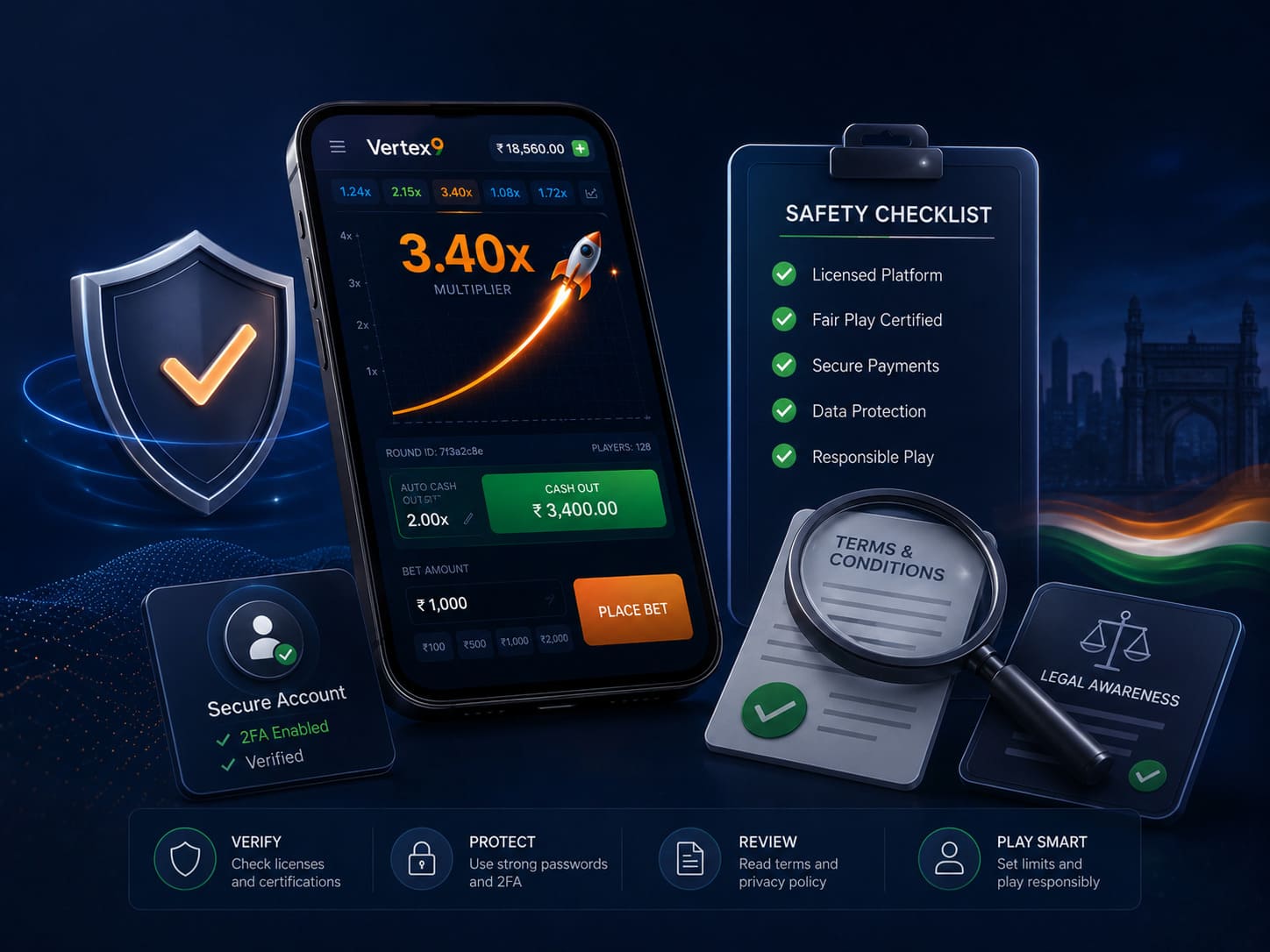
The financial result of a round is not the only risk.
An unverified platform may also create problems involving identity documents, payment information, account access and withdrawals.
Withdrawals May Be Delayed or Refused
A site may accept a deposit quickly but place additional conditions on withdrawals.
It might request repeated identity checks, claim that a bonus has not been completed or demand an additional payment before releasing the balance.
A request to pay a “tax”, “security deposit”, “verification fee” or “unlocking charge” directly to an agent should be treated with extreme caution.
Sending more money does not guarantee that the original balance will be released.
Personal Documents May Be Misused
Some platforms request Aadhaar, PAN, bank statements, selfies or other identity documents.
Know-your-customer checks can exist in legitimate financial services, but submitting sensitive documents to an unclear offshore operator creates a separate privacy risk.
Before sharing anything, users should know who controls the company, where the information is stored, why each document is required and how it can be deleted.
Unofficial APK Files Can Carry Additional Risks
An app shared through a private message, shortened link or Telegram group may not have gone through normal app-store checks.
It may ask for access to messages, contacts, photos, notifications or accessibility controls that have little connection to gameplay.
Installing an unknown file can expose more than a gaming account. It can expose the entire device.
A Foreign Licence Does Not Settle the Indian Legal Question
A platform may display a licence number from another jurisdiction. Even where that licence is genuine, it only describes the operator’s position under the issuing jurisdiction’s rules.
It does not automatically establish permission to offer real-money games in India.
What Should You Do If Your Money Is Already Stuck?
Do not send another payment simply because a customer-service agent says it is required to release the first one.
Save everything connected with the transaction, including screenshots, payment receipts, UTR or transaction numbers, account details, chat messages, email records and the website or app address.
Contact the bank, wallet or payment provider as soon as possible. Where an unauthorised or fraudulent electronic transaction is suspected, the Reserve Bank of India advises customers to notify their bank immediately and obtain an acknowledgement.
Suspected cyber financial fraud can also be reported through India’s National Cyber Crime Reporting Portal or the national helpline 1930, which operates across states and union territories.
Acting quickly may improve the chance of stopping or tracing a transaction, although recovery is never guaranteed.
Avoid giving remote access to the phone or computer. A person claiming to help with a refund should not need an OTP, UPI PIN, banking password or screen-sharing control.
How to Recognise Misleading Crash Game Advertising
Be cautious when an advertisement concentrates entirely on winnings while saying little about losses.
Typical warning signs include:
- Claims of guaranteed daily income
- Screenshots without verifiable transaction records
- “Secret” signals available only after payment
- Pressure to deposit immediately
- Bonuses described without complete conditions
- Agents asking for transfers to personal bank accounts
- Requests to recruit friends before a withdrawal is processed
- Instructions to use a VPN or change the device location
- Promises that no verification will ever be required
A legitimate explanation of a risky product should be willing to discuss what can go wrong. Marketing that presents every user as a likely winner is not giving a balanced picture.
Are Free Crash-Style Games a Better Alternative?
A free crash-style game removes the immediate risk of losing deposited money.
It can show how the multiplier and cash-out mechanics work, but users should still pay attention to the way the game is designed. Even without real-money stakes, rapid rounds and constant reward cues can encourage long sessions.
A safer free-play product should clearly state that virtual points have no cash value, cannot be withdrawn and cannot be sold or exchanged outside the game.
Other alternatives include casual arcade games, puzzle games and online social games where payment, where present, is limited to ordinary access or cosmetic content rather than being staked for a financial return.
India’s current framework treats e-sports and qualifying online social games differently from online money games, provided they meet the relevant definitions and requirements.
Frequently Asked Questions
What does “crash game real money” mean?
It generally refers to a crash-style game in which a player deposits or stakes actual money and attempts to cash out at a rising multiplier before the round ends.
The possible return depends on the multiplier reached at the time of cash-out. Waiting longer may offer a larger displayed return, but it also creates a greater possibility that the round will end first.
Are real-money crash games legal in India in 2026?
India’s current national framework prohibits online money games, their advertising and the facilitation of related payments. The definition covers games involving money or other stakes in expectation of monetary returns, whether the outcome depends on skill, chance or both.
A typical real-money crash game is likely to fall within that broad definition, although the formal legal classification of a particular product depends on its actual structure and any determination by the relevant authority.
Does an offshore licence make a crash game legal in India?
Not automatically.
A foreign licence relates to the laws of the jurisdiction that issued it. India’s legislation expressly covers online money gaming services operated outside India when they are offered within Indian territory.
Can a VPN make a real-money crash game legal?
A VPN changes how an internet connection appears. It does not change the law that applies to the user or service.
It may also breach a platform’s terms, interfere with verification and create additional account or withdrawal problems.
Can the next crash multiplier be predicted?
There is no dependable way for an ordinary player or third-party predictor app to know the next result in advance.
Patterns in previous rounds can look meaningful, but they do not provide a reliable basis for forecasting a future crash point.
Does automatic cash-out guarantee a return?
No.
Automatic cash-out only activates if the multiplier reaches the chosen point before the round crashes. It does not guarantee that the selected multiplier will be reached.
Is a demo crash game the same as a real-money game?
No.
A genuine demo uses non-withdrawable virtual credits and does not require real stakes. A real-money version involves an actual financial loss or gain.
The distinction becomes less clear where virtual items can be purchased, transferred, sold or converted into money or something equivalent to money.
What should I do if a platform asks for another deposit before allowing a withdrawal?
Do not send more money without independently verifying the request.
Save the transaction records and messages, contact the payment provider and report suspected financial cyber fraud promptly through the appropriate Indian authorities, including the 1930 helpline or National Cyber Crime Reporting Portal.
Final Thoughts
A crash game is easy to understand, but that does not make it easy to control.
The player decides when to cash out, yet the game decides whether that opportunity arrives. Fast rounds, rising multipliers and near misses can make the experience feel more predictable than it really is.
For anyone searching for crash game real money in India, the legal position is now just as important as the gameplay. India’s current framework broadly prohibits online money games, including their promotion and related payment activity.
A website being accessible does not prove that it is approved. An overseas licence does not automatically settle the Indian legal position. A successful withdrawal by another user does not guarantee that the same will happen again.
The safest approach is to avoid staking real money and choose genuinely free social or demo games where there is no deposit, no cash withdrawal and no pressure to recover a loss.
Best Crash Game Real Money App India: Vertex9
For players searching for the best crash game real money app India, Vertex9 offers a straightforward place to explore fast-paced crash-style gameplay. The format is easy to follow: the multiplier rises, and players must decide when to cash out before the round ends. Vertex9 is designed for mobile-friendly play, making it convenient for users who prefer quick sessions on their phone. Before playing, it is still important to read the game rules, understand any account verification requirements and check the platform’s deposit, bonus and withdrawal terms carefully. Crash games are unpredictable, so no cash-out target or betting pattern can guarantee a profit. Players should only use money they can comfortably afford to lose, set a firm spending limit and confirm that real-money online gaming is permitted in their location before accessing Vertex9.
You may also like to know:
Online Slots India: Games, Bonuses and Safer Play Guide
Super Andar Bahar: Complete Online Guide for Indian Players
Paise Kamane Wala App: How to Earn Money Online in India
Online Blackjack India: A Complete Guide for Indian Players
Cricket Satta in India: A Complete Guide for Cricket Fans
Aviator Game Hindi: A Simple Guide for Indian Players
UPI Withdrawal Game in India: Fast Withdrawals, How They Work and What to Check
Andar Bahar App India: A Simple Guide for Online Players
Fast Withdrawal Game India: How to Find Games with Quick Payouts
3 Patti Real Cash in India: Rules, Risks and the 2026 Legal Position
NetBet Aviator India: How to Play, Features & Game Guide 2026
Teen Patti Real Cash: A Complete Guide for Indian Players
Cricket Betting Tips Today: A Practical Guide for Indian Bettors
Satta App India: A Simple Guide to Choosing the Right Online Satta App
Crypto Casino India: A Complete Guide for Indian Players
Live Dealer Casino India: Play Real Casino Games Online
Best Cricket Betting Sites in India 2026: Trusted Platforms Compared
IPL Live Streaming Free APK: Safe Ways to Watch IPL on Mobile
Online Roulette India: A Complete Guide to the Game
Aviator Game Se Paise Kaise Kamaye: Tips for Smarter Play
Best Football Betting Sites in India: Trusted Online Bookmakers Guide
Andar Bahar Casino India: Rules, Gameplay and Winning Tips
Online Satta in India: Games, Results, Risks and Rules
Aviator Hack: Can the Game Really Be Predicted or Manipulated?